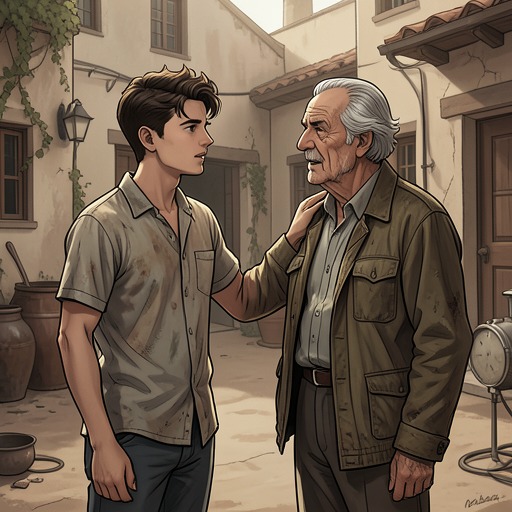
Driss recruits Ismael for an unspecified scheme
The ForgivenDriss recruits Ismael into an unspecified scheme by linking a shared ambition—to make money and leave for the city—to a demand that Ismael set sentiment aside and show courage. The exchange turns their companionship into a tentative partnership, but its terms remain concealed: Ismael assents before he knows what Driss intends, and the promised explanation is postponed until after they finish smoking. The scene establishes a willingness to embark, not the scheme itself or its outcome.
Setting and Immediate Purpose
The conversation takes place beside a dying fire on the plain, with the fossil trenches of the quarry and Hmor Lagdad under the wind. Driss rolls another joint while the two listen to the sound sweeping across the landscape. The wind is familiar to them from a lifetime of hearing its different textures, while the compressor shines with a metallic light that seems to reflect a source of radiance they cannot identify. This setting places their small, immediate plans against an immense landscape and its deep past: the wind has crossed the ground for millions of years, perhaps when it was sea, while the men are considering how to get away from the place where they live.
Their immediate objective is practical. As the fire begins to die, Driss says he has been thinking about how they might make money for themselves and then leave for the city. He presents departure as a goal Ismael already shares, and Ismael confirms that he wants it. The exchange gives the recruitment a mutual premise rather than making it a simple command: Driss offers a route toward money and escape, and Ismael is receptive to that destination before he knows the means.
Driss’s Recruitment
Driss makes the bond between them explicit by describing Ismael as ambitious, as he considers himself to be. Neither needs to turn this comparison into a formal promise; they tacitly agree that it is true. That shared self-description helps Driss cast the unknown plan as an expression of who they are, not merely an offer of work. Ismael’s assent to the prospect of leaving therefore precedes any knowledge of the risk or task involved.
The actual scheme remains deliberately vague. When Ismael asks what Driss has in mind, Driss smiles cryptically and says it will require pluck and the abandonment of sentimentalism. The language announces a threshold without identifying what lies beyond it. Driss is asking Ismael to accept a manner of acting—bold, unsentimental, and not overly reflective—before he supplies the practical details. The secrecy makes the recruitment itself the scene’s central action: Driss is testing whether Ismael will commit to an attitude and to him before learning the plan.
Ismael’s Response and the Conditions of Agreement
Ismael resists Driss’s characterization of him as sentimental. He says he is not, but Driss answers that he has been so up to now and will have to become a warrior from then on, without thinking too much. The contrast is drawn by Driss, who defines the change he wants from Ismael in stark terms: the tentative or reflective disposition he attributes to his companion must give way to nerve and action. The text does not establish whether Ismael accepts this account of his past; it shows him pushing back against the label even as he agrees to the demand.
Ismael says he can do what Driss asks, yet qualifies his assent by admitting that he cannot know for certain. Annoyance enters his voice, and Driss soothes him. This response keeps the agreement from seeming wholly settled. Ismael has consented, but his uncertainty and irritation register the pressure built into Driss’s approach: the request is made before the purpose is disclosed, and the terms are framed as a test of character. Their emerging alliance thus contains both cooperation and friction.
Deferred Explanation and Narrative Significance
Driss promises to explain the plan after they have finished smoking. Ismael mutters that he hopes he will, then lies on his side with one hand beneath his head so he can keep looking toward the road. There is nothing on it; he sees only the white posts along its edge. The road supplies a concrete image of the possibility of departure, but at this moment it offers no visible movement or answer. Ismael’s attention remains on it while the promised scheme remains out of view.
Driss then suggests that they sleep first because they are both tired. The conversation consequently ends not in disclosure or action but in postponement. The recruitment has advanced far enough for Ismael to agree in principle, yet the reader, like Ismael, is left without the scheme’s details. That gap creates suspense while preserving an important distinction: Driss has secured a tentative accomplice for a future attempt to make money and leave, but neither the exact plan nor its execution is revealed in this scene.